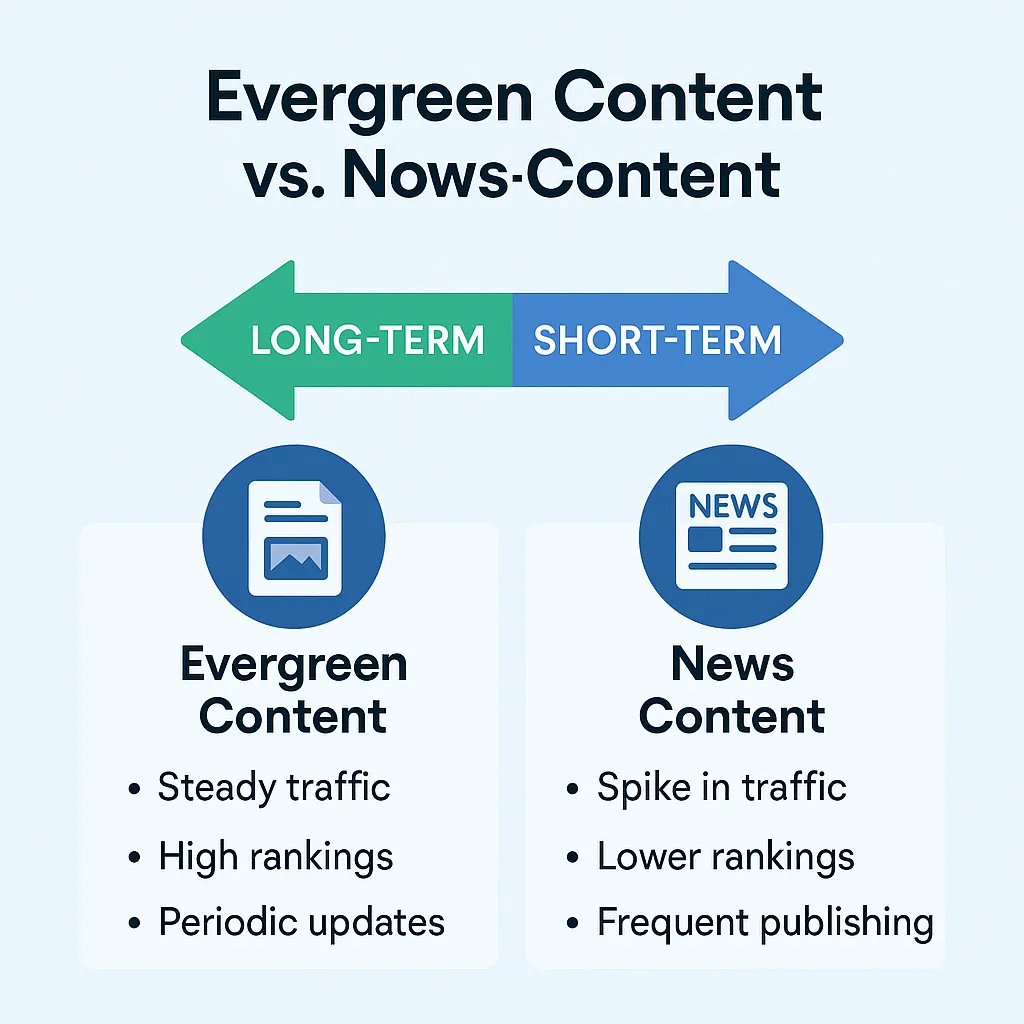
When planning a content strategy, one of the most common questions is: should I invest in evergreen content or news articles? The truth is that both play important roles in SEO and audience engagement. Knowing when and how to use evergreen content vs. news can transform your traffic growth, authority, and even conversions.
In this article, we’ll dive deep into:
-
What evergreen content is and why it matters
-
What news content is and how it drives traffic
-
Pros and cons of each
-
SEO impact and keyword strategies
-
Practical examples and tips to balance both
What Is Evergreen Content?
Evergreen content refers to articles, guides, or resources that remain relevant for a long time. Much like an evergreen tree that stays green year-round, this content continuously attracts traffic months or even years after publishing.
Examples of Evergreen Content:
-
“How to Improve Your SEO Ranking Step by Step”
-
“The Ultimate Guide to Social Media Marketing for Beginners”
-
“Best Hiking Trails in Piemonte: Complete 2025 Guide”
Why Evergreen Content Matters for SEO
-
Long-term traffic: Once ranked, evergreen posts bring consistent visitors.
-
Backlink potential: Guides and resources are often linked by other websites.
-
Keyword stability: Evergreen keywords usually have stable search volumes over time.
-
Lower maintenance: Occasional updates keep the content fresh without rewriting from scratch.
Keywords for evergreen strategy: evergreen content examples, long-term SEO strategy, evergreen blog posts
What Is News Content?
News content focuses on current events, trends, or updates. It’s time-sensitive, quickly attracting attention but often losing relevance once the news cycle passes.
Examples of News Content:
-
“Google Releases Core Update August 2025 – What Changed?”
-
“New AI Tool Transforms Digital Marketing Strategies”
-
“Tourism in Piemonte Grows 20% After Summer Festival”
Why News Content Matters for SEO
-
Instant traffic boost: News can spike visits within hours of publication.
-
Topical authority: Covering industry trends positions you as a thought leader.
-
Social sharing: News spreads faster on social media platforms.
Keywords for news strategy: SEO news, digital marketing trends, content marketing updates
Evergreen vs. News: Key Differences
| Factor |
Evergreen Content |
News Content |
| Lifespan |
Long-term (months/years) |
Short-term (days/weeks) |
| Traffic |
Steady, consistent |
Immediate, high peaks |
| SEO Impact |
Strong long-term rankings |
Quick visibility, but fades fast |
| Update Frequency |
Low – occasional refresh |
High – needs constant publishing |
| Best For |
Guides, tutorials, resources |
Industry updates, announcements |
When to Use Evergreen Content
You should focus on evergreen content when your goal is:
-
Building long-term organic traffic
-
Establishing authority in your niche
-
Attracting backlinks naturally
-
Answering common, recurring questions from your audience
Example for SEO site:
Instead of writing “SEO Trends in 2023,” create “The Complete Beginner’s Guide to SEO” — which stays relevant and useful for years with small updates.
When to Use News Content
You should invest in news content when your goal is:
-
Driving short-term spikes in traffic
-
Building visibility as a trend leader
-
Increasing engagement on social media
-
Ranking for time-sensitive keywords
Example for tourism site:
Instead of only evergreen posts like “Best Places to Visit in Piemonte,” you can also cover “Piemonte Wine Festival 2025: Full Event Guide.”
Balancing Evergreen Content and News in Your Strategy
The real secret to content success isn’t choosing one over the other — it’s balancing both evergreen content and news.
Step 1: Use Evergreen as the Foundation
Your blog should have pillar evergreen posts that consistently bring in organic traffic. Think of them as the roots of your content strategy.
Step 2: Add News for Authority & Freshness
Sprinkle in news updates to show your readers (and Google) that your site is alive, updated, and in tune with trends.
Step 3: Interlink Both Types
Use internal linking between evergreen and news posts. Example: A news post about “Google’s Core Update” should link to your evergreen “SEO Guide.” This boosts authority and rankings.
Step 4: Repurpose News into Evergreen
Some news articles can be repurposed. Example: A news piece on “Top Travel Trends 2025” can later evolve into an evergreen “How Travel Trends Are Shaping Tourism.”
SEO Tips for Evergreen Content
-
Target high-volume, stable keywords like how to do SEO, content marketing strategy, best tools for bloggers.
-
Optimize for featured snippets by answering direct questions.
-
Update yearly with fresh stats and examples.
-
Use long-form content (1500+ words) for authority.
SEO Tips for News Content
-
Target low-competition, trending keywords like Google update August 2025.
-
Use fast publishing to capture attention before competitors.
-
Leverage Google News & Discover for visibility.
-
Promote heavily on social media & newsletters to maximize reach.